Enchant: Reviving Medieval Charm for Modern Design
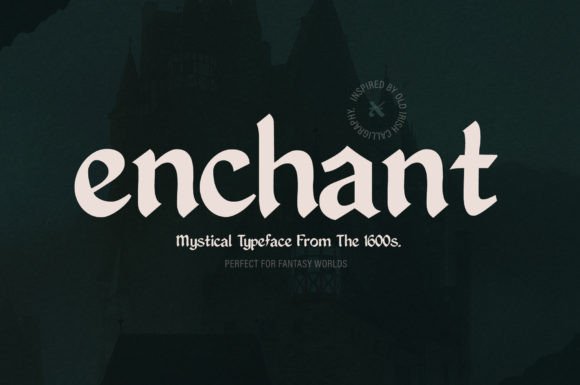
There’s something undeniably magnetic about typography that carries history in its curves. When you first see Enchant, it doesn’t just sit on the page—it transports you. This isn’t just another script font; it’s a carefully crafted nod to the 1600s, drawing deep from Celtic artistic traditions. For designers and creators today, finding a typeface that balances historical weight with contemporary legibility is rare. Enchant manages to bridge that gap, offering a calligraphic texture that feels authentic to the medieval era but clean enough for modern digital and print applications. It captures the essence of a time when letters were hand-carved and illuminated, providing an instant layer of depth and narrative to any project it touches.
The Visual Identity of Enchant
Understanding the anatomy of Enchant is key to using it effectively. At its core, it is a display typeface. You wouldn’t use it for body text in a long-form report, but for headlines, logos, and branding, it is a powerhouse. The letterforms feature the distinct, ornamental strokes characteristic of Celtic calligraphy, yet they are spaced and weighted to ensure clarity. This is a crucial distinction. Many vintage or historical fonts suffer from illegibility, forcing the viewer to squint or guess at the letters. Enchant prioritizes readability while maintaining its decorative flair.
The personality of this font is one of elegance, tradition, and mystery. It carries the visual weight of a serif font but with the fluidity of a script font. The letter connections are thoughtfully designed to prevent the text from looking like a tangled knot. When you look at the capital letters, you see the influence of illuminated manuscripts—ornate yet structured. The lowercase letters flow with a rhythm that guides the eye naturally from left to right. This makes it a versatile creative font for projects that need to convey a sense of heritage, fantasy, or sophistication.
Strategic Applications: Where Enchant Excels
The true test of a premium font is its adaptability across different mediums. Enchant is not limited to one niche; its utility spans a wide array of creative and commercial sectors. For entrepreneurs and small business owners, the font offers a way to build a distinct brand identity that stands out in a crowded marketplace.
Here is where Enchant shines brightest:
- Publishing and Editorial Design: It is ideal for book covers, particularly in the fantasy, historical fiction, or mystery genres. The font instantly sets the mood on a magazine cover or a chapter heading, signaling to the reader the tone of the content before they read a single word of the story.
- Packaging Design: If you are designing for artisanal products—craft beers, organic teas, hand-bound journals, or specialty foods—Enchant adds a layer of perceived quality. It suggests craftsmanship and care, which can influence a customer's decision to pick up a product from a shelf.
- Digital and Social Media: In the fast-scrolling world of Instagram, Pinterest, and TikTok, visual hierarchy is everything. Using Enchant for social media graphics can stop the scroll. It works exceptionally well for quotes, event announcements, or headers on a blog, providing a striking contrast to modern sans serif fonts.
- Merchandise and Apparel: For t-shirts, emblems, and posters, this typeface provides a "vintage" look without needing heavy distressing. It works well for band logos, festival merchandise, or boutique clothing lines looking for a medieval font aesthetic.
Mastering Font Pairings and Visual Hierarchy
A common mistake in graphic design is using a decorative font for everything. Because Enchant is a high-impact display typeface, it demands a supporting cast. This is where the art of font pairing comes into play. To let Enchant breathe and maintain a professional look, you should pair it with something simple and understated.
For a clean, modern contrast, pair Enchant with a geometric or humanist sans serif font. The clean lines of the sans serif will act as a neutral canvas, allowing the intricate details of Enchant to take center stage without overwhelming the viewer. Alternatively, if you want to maintain a vintage feel, a classic old-style serif for your body text can create a cohesive, historical narrative. The key is contrast in complexity. If the headline is complex, the body must be simple.
When using Enchant for logo design, pay close attention to tracking (letter spacing). Celtic-inspired fonts often benefit from slightly tighter tracking to create a unified symbol, or slightly looser tracking to let the intricate details shine in larger formats. Always test your pairings at different sizes. A combination that looks great on a desktop screen might become muddy on a mobile device if the secondary font isn't optimized for web design.
Evaluating Fit and Practical Considerations
Before committing to Enchant for a major project, it is wise to evaluate the specific needs of your design. Ask yourself: Does my audience appreciate historical or fantasy aesthetics? Is the goal to convey warmth and tradition, or sleek futurism? If it is the latter, this might not be the right tool. However, if you are aiming for a brand identity that feels grounded, authentic, or magical, Enchant is a strong candidate.
Legibility testing is non-negotiable. While Enchant is designed to be legible, context matters. Test it against your background images or textures. Ensure there is enough contrast. If you are using it for packaging design, print a physical mockup. Screen resolution can sometimes smooth over details that look different in ink. Check the font license as well. For commercial projects—whether it’s a client logo or merchandise you plan to sell—ensure you have the appropriate commercial license. Respecting font licensing is a hallmark of a professional designer.
Finally, explore the full character set. High-quality fonts like Enchant often include stylistic alternates, ligatures, and extended language support. These extra glyphs can elevate a design from "good" to "bespoke." By swapping out a standard "t" for a stylistic alternate, you can change the entire flow of a word, making your typography feel truly customized.
Conclusion: Timeless Typography for the Modern Creator
In an era dominated by modern typography and minimalism, there is a growing hunger for designs that feel human and historical. Enchant answers that call. It is more than just a creative font; it is a design asset that connects the present with the past. Whether you are a publisher crafting a cover for a historical epic, a marketer designing a campaign for a heritage brand, or a hobbyist creating a personal project, this typeface offers a reliable way to inject personality and professionalism into your work. By understanding its strengths, respecting its complexity, and pairing it wisely, you can use Enchant to create designs that are not only seen but felt.